
Bible Study: Believing without seeing — the second miracle at Cana
John 4:43–54

Click here to read the passage, John 4:43-54.
Believing without seeing: The second miracle at Cana
Main Idea
True faith trusts Jesus’ word before seeing the result.
Summary
After leaving Samaria, Jesus returns to Galilee and comes again to Cana, where he performed his first miracle, turning water into wine.
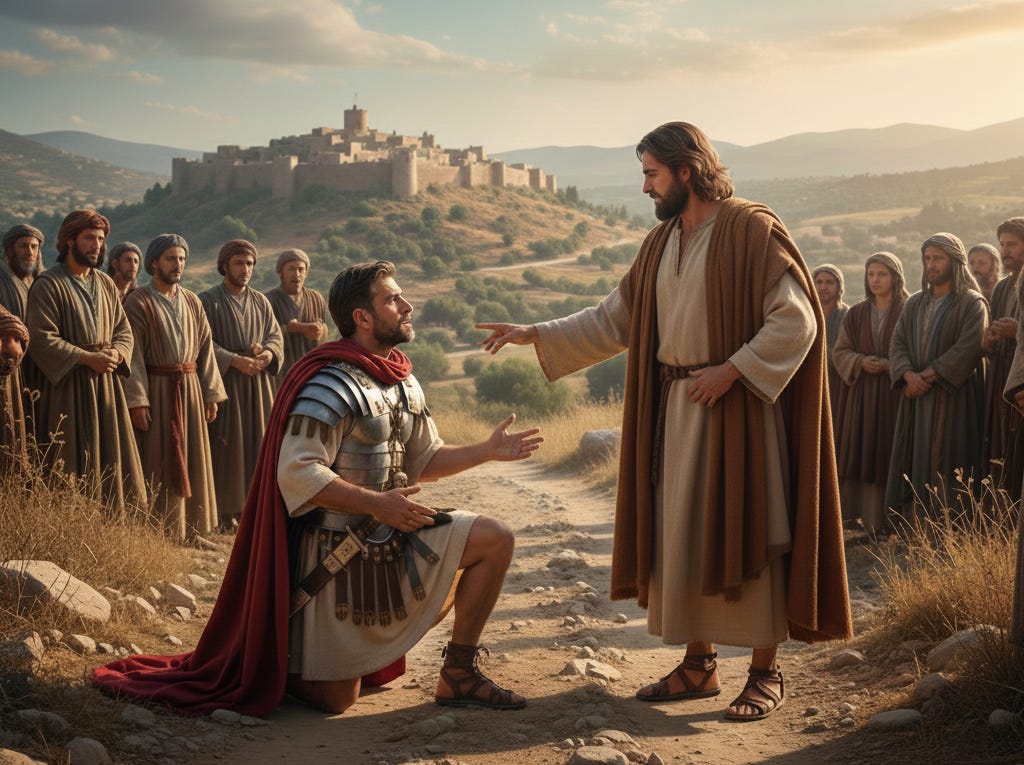
A royal official from Capernaum pleads with Jesus to heal his dying son. Jesus challenges the crowd’s dependence on signs but tells the man, “Your son will live.”
The official believes Jesus’ word and begins the journey home. On the way, servants confirm that the boy was healed at the exact moment Jesus spoke. The man and his entire household come to faith.
Commentary
John intentionally places this story after Jesus’ encounter with Nicodemus and the Samaritan woman to show that the gospel reaches every kind of person — a Jewish teacher, a social outcast, and an official for the Roman government. And by implication from those examples, to everyone in the world.
According to the ESV Study Bible, the official likely served Herod Antipas and was probably a Gentile centurion. His journey of nearly 50 miles shows desperation and humility.
Jesus does not travel with him or perform a visible act. Instead, he speaks a word from a distance, demonstrating divine authority not limited by geography.
Jesus’ rebuke about signs is not a rejection of miracles but a warning: signs are meant to lead people to faith in him, not replace faith.
The official’s belief matures — from seeking a miracle, to trusting Jesus’ word, to full household faith.
Key Takeaways
Jesus’ power is not limited by distance or circumstance.
Faith often begins imperfectly but can grow stronger.
Believing Jesus’ word is more important than seeing proof.
Signs are meant to point to who Jesus is, not distract from him.
Jesus welcomes people from every background into saving faith.
Obedient trust often comes before visible confirmation.
One person’s faith can influence an entire household.
Quotes
D. A. Carson (Evangelical New Testament scholar): “The official must decide whether he trusts Jesus himself or merely Jesus’ power.”
Andreas Köstenberger (Baptist New Testament scholar): “The miracle reveals Jesus as giver of life, not only physically but spiritually.”
John Calvin (A central figure of the Protestant Reformation who died in 1564): “Faith rests not on what the eyes perceive, but on the promise God has spoken.”
Questions
What stands out about the official’s desperation?
Why does Jesus challenge the desire for signs and wonders?
How is this healing different from others Jesus performs?
What risk did the official take by trusting Jesus’ word alone?
Why do you think Jesus did not go with him to Capernaum?
Where do you struggle to trust Jesus without visible proof?
How has your faith grown from initial belief to deeper trust?
How might your faith influence others in your household or circle?
A word for me today!