
Bible Study: Jesus raises Lazarus, declares himself 'the resurrection and the life'
John 11:1-44

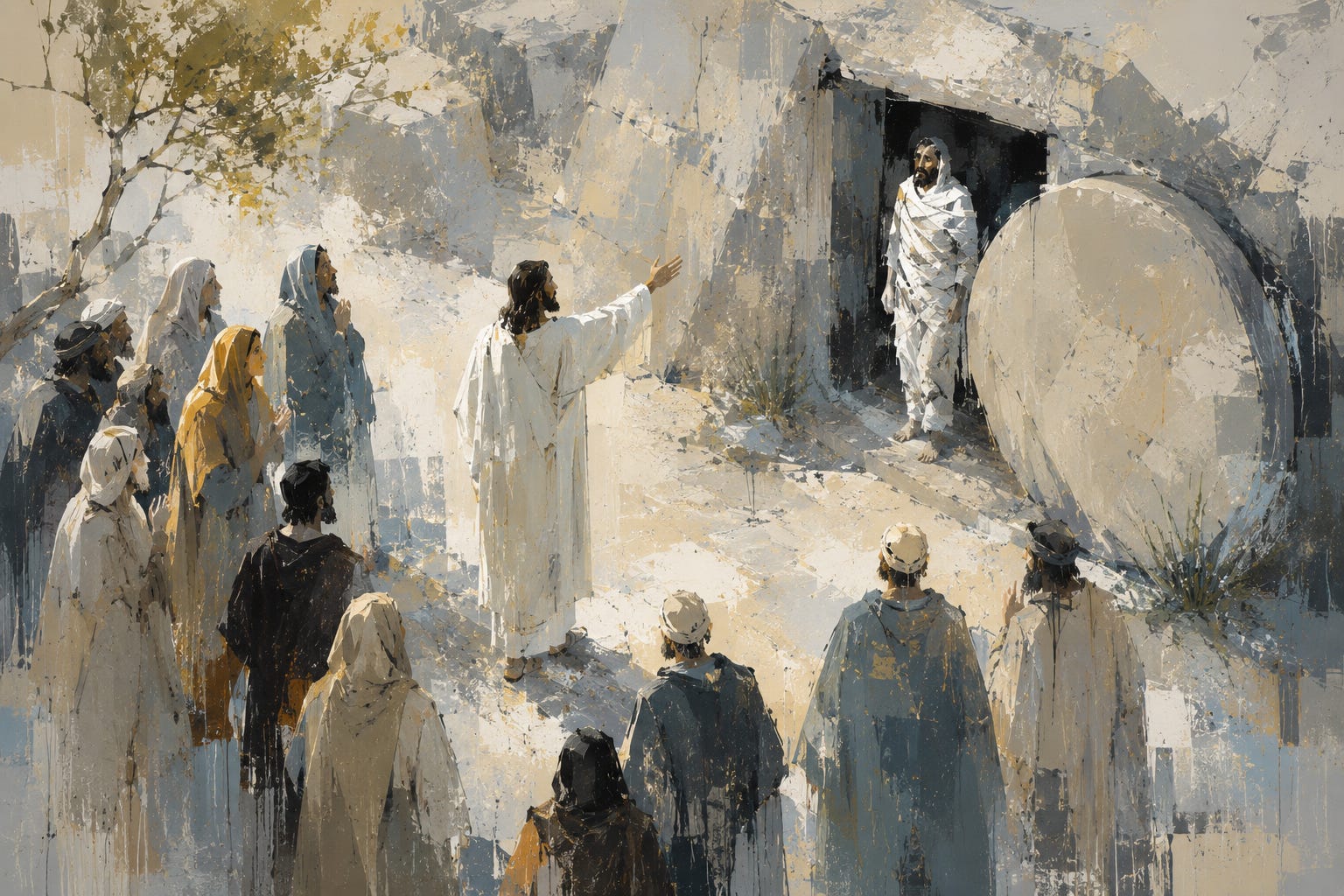
Click here to read the passage, John 11:1-44.
Jesus raises Lazarus, declares himself ‘the resurrection and the life’
Main Idea
Jesus reveals his power over death and his deep compassion by raising Lazarus, showing that he is both fully God and deeply present in human suffering.
Summary
John 11 tells the story of Jesus raising Lazarus from the dead, which is the final and ultimate messianic “sign” of Jesus in John’s gospel.
The raising of Lazarus (recorded only by John) also serves as a final event triggering the Jewish leaders’ resolve to have Jesus arrested and tried for blasphemy.
After hearing that his friend is ill, Jesus delays visiting Bethany — not because he doesn’t care, but because he plans to use the event to bring glory to God.
Lazarus dies, and by the time Jesus arrives, he has been in the tomb for four days. Both Martha and Mary express grief and disappointment.
Jesus responds with one of his clearest claims to deity: “I am the resurrection and the life.”
He then goes to the tomb, weeps, and calls Lazarus out — restoring life and pointing forward to his own resurrection.
Notes
Bethany is a village about two miles from Jerusalem. This is almost certainly the modern village of El-Azariyeh (an Arabic name that likely recalls the name of Lazarus) on the eastern slopes of the Mount of Olives. A fourth-century chapel was built over a rock-cut tomb traditionally thought to have been the tomb of Lazarus. Other first-century tombs are found in the hillside around this chapel.
Lazarus was dead for four days. Though burial usually followed soon after death, some later Jewish sources indicate a belief that the soul hovered over the body for three days, hoping to reenter it, but then gave up and departed. By waiting four days, Jesus made it unmistakably clear that Lazarus was truly dead.
Commentary
John is doing more than recording a miracle. He is revealing who Jesus truly is.
One striking feature of the chapter is the relationship between love and delay. John explicitly says Jesus loved Martha, Mary and Lazarus, yet Jesus intentionally waits before going to Bethany.
That challenges the common assumption that God’s love always means immediate relief from suffering.
In this passage, Jesus’ delay is purposeful. He intends to reveal a greater glory through resurrection power.
Jesus also reframes the entire conversation about death. Martha believes in a future resurrection “on the last day,” which reflected orthodox Jewish belief.
Jesus does not deny that future hope, but he shifts the focus to himself: “I am the resurrection and the life” (John 11:25).
Resurrection is not merely an event on God’s calendar. It is bound up in the person of Christ. Eternal life is not simply about life after death but about knowing and trusting Jesus now.
The emotions of Jesus are also important. His tears are not signs of helplessness. The text suggests deep anger and sorrow in the face of death and unbelief. Jesus confronts death as an enemy he has come to defeat.
Lazarus himself also points beyond the miracle. He is raised, but he will eventually die again. His resurrection is temporary and anticipates something greater: the coming death and resurrection of Jesus.
Unlike Lazarus, Jesus will rise in a glorified body never to die again. John wants readers to see Lazarus’s tomb as a preview of Christ’s victory over death.
Finally, the chapter forces a decision. Throughout John 11, people respond to Jesus in different ways — faith, confusion, hostility and worship. The same is true today.
Jesus does not present himself merely as a teacher or moral guide. He claims authority over life and death itself. The question of the chapter is whether we believe him.
Key Takeaways
Jesus delays out of love (v.5–6), not indifference — his timing serves a greater purpose.
Jesus grieves with us — his tears show real compassion (v.35).
Jesus claims to be the resurrection — not just one who gives it, but the resurrection itself (v.25).
The miracle is a sign — it reveals his divine authority and foreshadows his own resurrection.
Faith is central — Jesus calls Martha (and us) to believe even before the miracle (v.26).
Death doesn’t have the final word when Jesus is present.
Quotes
N. T. Wright (Anglican bishop and New Testament scholar) — “Jesus’ tears are those of the Word made flesh. His crying at Lazarus’s tomb is the sign that the God who made the world and loves it still is not indifferent to its suffering.”
Frederick Buechner (Presbyterian minister who died in 2022) — “Lazarus comes stumbling out into the daylight, wrapped up like a mummy. And you and I — we’re all Lazarus, in need of a voice that calls us out of the grave.”
Sinclair Ferguson (Scottish pastor) — “Jesus delayed so that the glory of God might be revealed. Sometimes his delays are not denials but divine setups for something greater.”
Questions
What sticks out to you in the key takeaways and quotes — and why?
In what ways do you relate to Mary and Martha in their grief and confusion?
Why do you think Jesus wept if he knew he would raise Lazarus? What do Jesus’ tears teach us about God’s heart toward suffering?
How do you respond when God delays answering a prayer? What does this story teach about divine timing?
Jesus says, “I am the resurrection and the life.” What does that mean to you personally?
What might it look like for you to trust Jesus with a situation that seems “too far gone”?
How does this story challenge your view of what it means for God to be glorified?